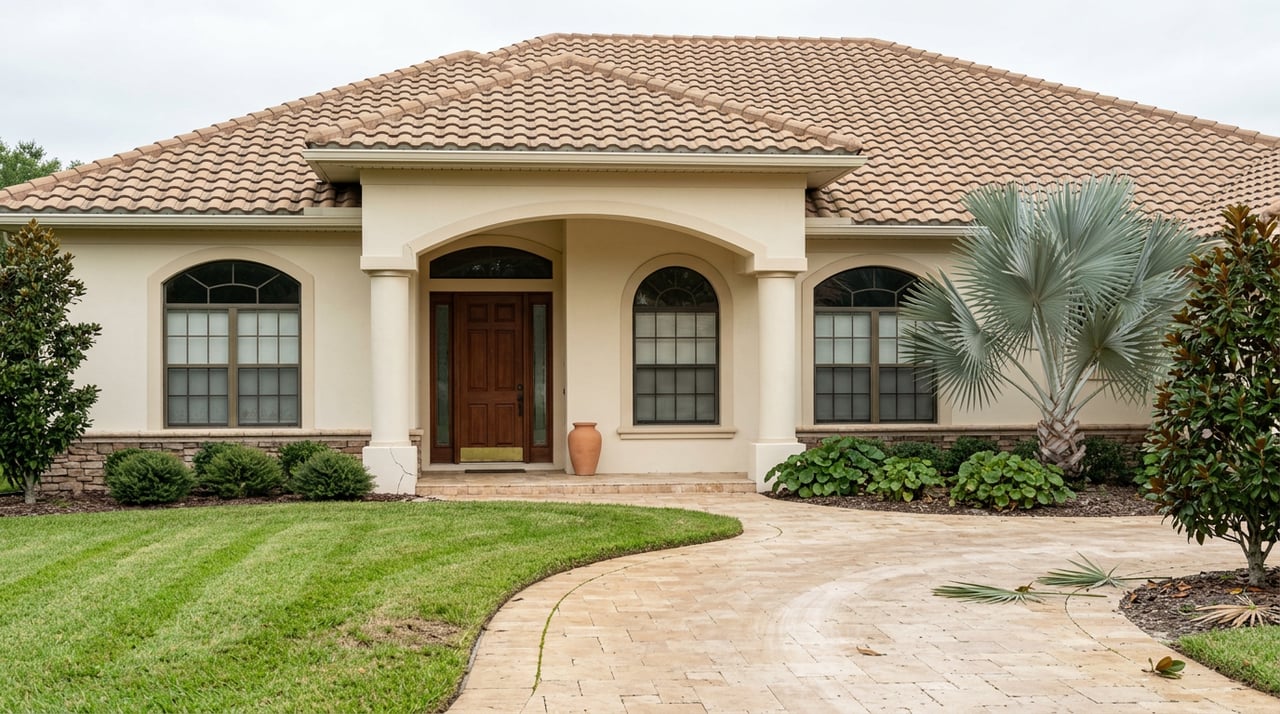
If a gated community advertises an average of nine days on market, what do you picture happening inside the gate? A bidding war on every driveway. A yard sign that barely has time to fade before it comes down. Buyers idling near the guardhouse hoping to hear about the next address before it hits a portal.
That is the story the nine-day number tells about Maitland Club. It is not the story the actual closings tell.
Look at the twelve months ending in June 2026 and a different picture appears. Four homes changed hands inside Maitland Club during that stretch. They took an average of 100 days to sell, closed at an average price of roughly $1,071,250 against an average asking price of $1,106,250, and worked out to about $229 per square foot. That is a respectable 97 percent list-to-sell ratio for a luxury pocket of Central Florida, but it is nowhere close to nine days.
Both numbers are real. Neither one is lying. The gap between them is the actual lesson here, and it matters more to a buyer or seller than either figure on its own.
Why Five Sales a Year Can Skew the Math
Maitland Club is a guard-gated subdivision of 114 homes on the western shore of Lake Charity, with its main entrance off Wymore Road. Communities this size do not turn over often. A typical year sees somewhere around five sales, which means the twelve months above, with four closings, is close to normal volume for the neighborhood, not an outlier.
Here is what that thin volume does to any average. Picture a year with five sales. Four of them are fairly ordinary transactions that each take two to three months, the kind of pace you would expect for a $1 million-plus home in a low-turnover community. The fifth is a property that hits the market already staged, priced sharply by a motivated seller, and gets snapped up in a week and a half. Average those five numbers together and the fast sale pulls the average down, even though four of the five sales looked nothing like that.
This is not a Maitland Club quirk. It is what happens to any average built from a handful of data points. In a subdivision that logs hundreds of sales a year, one unusually fast closing barely moves the needle. In a subdivision that logs four or five, it can shift the average enough to change how the small sample reads. A small-sample average can make individual transactions look like a market condition.
The Second Layer: Whose Boundary Are You Reading?
There is a second source of confusion sitting on top of the sample-size problem, and it has to do with what counts as "Maitland Club" in the first place.
Some portal data reflects a broader zip-code footprint around the community rather than the 114 homes actually behind the gate, and that wider slice can post a median price well below what the guard-gated subdivision itself has been closing at. If you are comparing neighborhoods by pulling numbers off different sites, you may be comparing a small luxury enclave on one page to a much larger surrounding area on another, without realizing the boundaries do not match.
The practical fix is simple, even if it takes an extra step. When a number seems out of step with the property type you are looking at, ask what geography it is actually measuring before you build a pricing strategy around it.
What $395 a Month Actually Buys
None of this is a knock on the neighborhood itself. Maitland Club is a genuinely well-run, guard-gated community, and the monthly HOA fee of $395 is doing real work behind that gate. It covers a 24-hour guard, grounds maintenance, upkeep of the community's internal roads, property insurance for common areas, and access to the community's recreation facilities, which include a tennis court and a playground rather than a golf course. This is a community built around privacy and low-maintenance living on the water, not around a country club calendar.
The location does a lot of the selling on its own. The community sits about three miles from the Altamonte Springs Mall corridor, where the bulk of nearby retail and dining is concentrated, and roughly two and a half miles from the Publix at Maitland Place for everyday errands. Lake Charity itself is the backdrop for the neighborhood's larger lots, and the gate and guard structure are the reason buyers pay a premium here rather than in a comparable non-gated pocket of Maitland.
What This Means If You Are Buying or Selling Here
If you are a buyer who found Maitland Club through a headline days-on-market figure, treat that number as a curiosity, not a strategy. The community is not going to behave like a fast-moving suburban subdivision where inventory turns weekly. With roughly five sales a year, you may watch the neighborhood for months before the right home appears at all, and when it does, plan for a normal luxury-home sales cycle rather than a race against other bidders. Patience is the actual entry price here, more than speed.
If you are a seller weighing whether to list, the small sample size cuts the other way in your favor. A thin market means fewer comparable sales to lean on, so pricing has to be built carefully around the handful of true comps rather than an average that might be hiding one unusually fast or slow outlier. A home that is staged, priced honestly against recent Maitland Club closings specifically, and marketed to the right buyer pool can still move efficiently. The 97 percent list-to-sell ratio over the past year suggests sellers who price close to the eventual sale value are getting close to their number, even if the calendar takes longer than a portal headline implies.
Either way, the number worth asking about before you act on this neighborhood is not "how fast do homes sell here." It is "how many homes actually sold here, and what did each one look like."
A Few Common Questions
Is Maitland Club a golf community? No. The gated community offers a tennis court and a playground as its shared recreation amenities, along with the 24-hour guard and lake frontage on Lake Charity, but there is no golf course inside the gate.
Why do different websites show such different price figures for Maitland Club? Some data reflects the guard-gated subdivision itself, where recent closings have averaged roughly $1,071,250 and about $229 per square foot. Other data reflects a broader zip-code area around Maitland Club that includes many homes outside the actual gated community, which pulls the median price down substantially. Always check what boundary a figure is actually describing.
How often do homes actually sell in Maitland Club? Typically around five sales a year across the 114-home community, which is why any single fast or slow closing can swing an average days-on-market figure well outside what a normal transaction there actually looks like.
If you are weighing Maitland Club against another Central Florida gated community, or trying to figure out what a specific price-per-square-foot number really means for your own timeline, that is exactly the kind of conversation Rebecca Simms has with buyers and sellers every week. Schedule a free consultation and get a straight read on what the numbers in any neighborhood you're considering actually say, not just what they seem to say at a glance.
This article is general information, not legal, tax or financial advice. Consult a qualified professional about your situation.